
Cozy Co-Author Review (2026): Honest Test, Real Results + Exclusive Bonuses
If you’ve ever thought, “I’d love to see my cozy fantasy novel on Kindle, but I’m not really a writer,” you’re exactly who this Cozy Co-Author review is for.
I’ve been experimenting with AI writing tools for a while, and I’ve seen the whole spectrum:
- surprisingly good drafts
- and absolutely unreadable “AI slop” that no sane reader would pay for
So when I saw Cozy Co-Author promising that two AI prompt files could help anyone write a publishable cozy fantasy series, I was curious but skeptical.
In this in-depth Cozy Co-Author review, I’ll cover:
- What Cozy Co-Author actually is (beyond the sales hype)
- My first-hand experience using it inside Claude
- The real pros and cons (including who should skip it)
- Whether the output is good enough to put your name on
- How I’d use Cozy Co-Author to build a Kindle Unlimited cozy series
- And two exclusive bonuses I’m giving you if you decide to grab it through my link
TL;DR: Cozy Co-Author is the first AI-based system I’ve used that genuinely feels like a co-author for cozy fantasy – not a gimmick. It still needs a human polish pass, but with that, I’d be comfortable publishing these books under a pen name.
What Is Cozy Co-Author?
Cozy Co-Author is a two-file AI framework designed specifically to help you write cozy fantasy novels and series using Claude (or another LLM).
Instead of one-off prompts, you get:
- A Cozy Fantasy Framework file
- A Setup Prompt file
- A 23-module training course showing you how to go from idea → draft → KDP → series
What Cozy Co-Author Claims To Do
Here’s what the creator promises, stripped of the copywriting:
- Turn a single cozy fantasy idea into a full novel (and eventually, a series)
- Guide you through 14 structured questions that create:
- a Story Bible
- character profiles
- a chapter outline
- Let Claude write your book chapter by chapter in a consistent cozy voice
- Prevent common AI writing problems:
- generic “purple” prose
- random paragraph breaks
- overdramatic, vague sentences
- Help you publish on Amazon KDP (including Kindle Unlimited) using step-by-step training
- Make this possible even if:
- you’re not “a writer”
- you’ve never finished a novel before
The price at the time of writing is $17 (launch price) with a 14-day refund guarantee, and it runs on free Claude (Pro is optional).
My First-Hand Test: Actually Using Cozy Co-Author In Claude
I didn’t want this Cozy Co-Author review to be theoretical, so I bought it and used it.
Here’s exactly what I did.
Step 1: Loading the Framework
I opened Claude and:
- Created a new project
- Pasted in the Cozy Fantasy Framework file
- Pasted in the Setup Prompt file
- Followed the instructions exactly
This isn’t a “magic 2-sentence prompt.” It’s a long, carefully engineered framework that tells Claude:
- how to think about cozy fantasy structure
- what kind of prose to avoid
- how to keep voice and continuity consistent from chapter 1 to chapter 25
It felt less like “prompting AI” and more like loading a custom writing engine.
Step 2: Running Setup (The 14-Question Planning Session)
The Setup phase was where Cozy Co-Author really started to stand out.
Instead of dumping you in a blank chat and saying “What’s your story idea?”, it:
- asks 14 guided questions
- gives you 3 options for each with explanations
- steers you toward a strong cozy fantasy setup
In about 45–60 minutes, I walked away with:
- A Story Bible (tone, setting, key themes)
- Detailed character profiles
- A chapter-by-chapter outline
- Notes on cozy worldbuilding and long-term series hooks
For most beginners, this planning alone would be days of work. Here, it was one focused session.
Step 3: Letting Cozy Co-Author Draft Chapters
With planning done, I told Claude:
“Please draft Chapter 1 using the Cozy Co-Author Framework and the planning docs we created.”
This is where I expected things to fall apart. Instead, I got:
- Consistent, grounded cozy fantasy prose
- A clear sense of place, character, and warmth
- Pacing that felt like actual cozy fantasy:
- small-town life
- gentle magic
- low stakes, high comfort
Crucially, it did not read like the typical AI sludge you see in 1‑star Kindle reviews:
- No dramatic one-word paragraphs
- No endless vague “Something shifted. Wrong. Unfamiliar.” nonsense
- No obvious “AI voice” crutches
With one light editing pass, I’d be comfortable putting this chapter into a real cozy fantasy book.
Step 4: Editing and Pushing the System
I didn’t rewrite. I:
- fixed a few lines for flow
- sharpened a couple of character beats
- nudged some dialogue
I also deliberately pushed the system with feedback:
- “Make this side character funnier and more dry.”
- “Lean more into food and sensory details here.”
- “Dial the conflict back a notch to keep it cozy.”
The framework responded well. It kept:
- the same voice
- the same cozy tone
- the same pacing
…even when I asked it to adjust flavor and emphasis.
That’s the difference between a prompt and a framework.
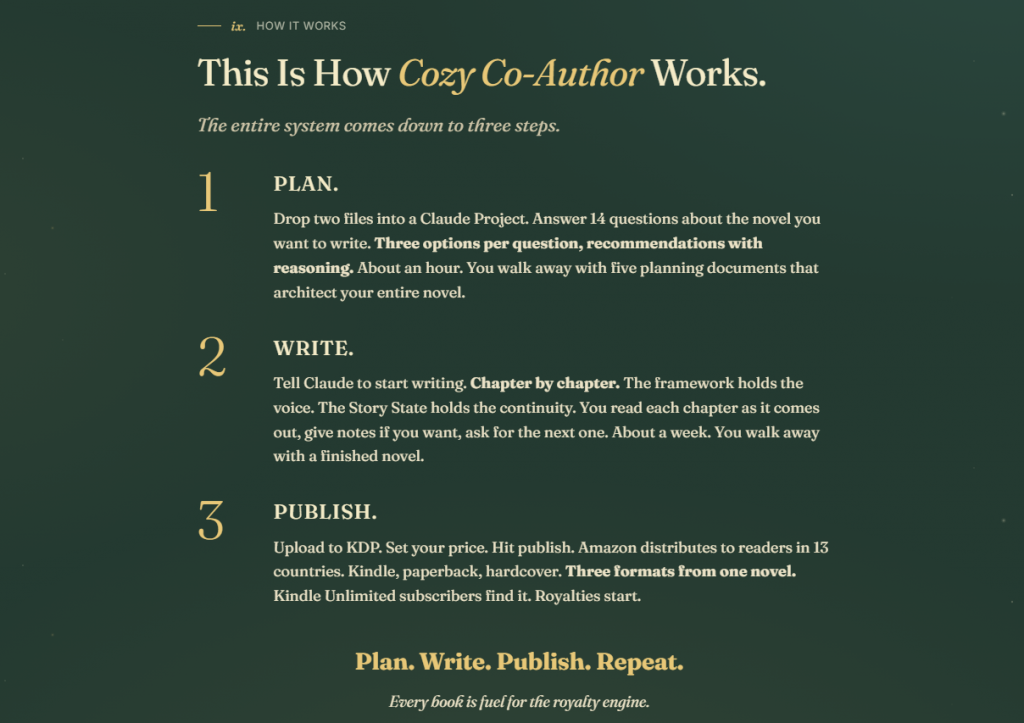
How Cozy Co-Author Works (Simple Overview)
Here’s the basic workflow, from your perspective.
1. Plan
Inside Claude:
- Paste in the Framework
- Paste in the Setup Prompt
- Answer 14 guided questions (mostly multiple-choice)
- Receive:
- Story Bible
- Character descriptions
- Setting overview
- Chapter outline
- Notes for potential sequels
2. Write
Still in Claude:
- Ask for Chapter 1
- Read it, tweak the instructions a little if needed
- Move on to Chapter 2, 3, etc.
- On free Claude, you’ll work in multiple sessions because of usage limits
- On Claude Pro, you can run much longer, smoother sessions
3. Polish & Publish
Outside Claude:
- Do a full read-through and a light edit
- Follow the 23-module Cozy Co-Author course to:
- format your book
- upload to KDP
- set categories and keywords
- enroll in Kindle Unlimited
- run basic promos and build a series
4. Repeat For the Series
Using the same project and framework:
- Plan Book 2 with another Setup session
- Draft it chapter by chapter
- Publish
- Keep building your cozy catalog
You don’t need to be technical. If you can copy, paste, and click through a dashboard, you’re fine.
Key Features (And What They Actually Do For You)
1. Cozy Fantasy Framework
What it is:
A long system prompt that encodes:
- cozy fantasy tropes and expectations
- pacing and tone guidelines
- banned AI clichés and formatting habits
- voice discipline
What it does for you:
Keeps Claude from drifting into weird AI behavior and helps your book actually read like it belongs on the cozy fantasy shelf.
2. 14-Step Guided Setup
What it is:
An interactive planning conversation with:
- multiple-choice answers
- recommendations and reasoning
- logical flow from concept → outline
What it does for you:
Removes blank-page paralysis. You don’t have to invent everything from scratch; you just make guided decisions.
3. Anti–AI-Slop Engineering
What it is:
Rules and constraints inside the framework to avoid:
- purple, overblown language
- endless introspection with no action
- weird line breaks that scream “AI”
- generic, vague phrasing
What it does for you:
Gives you a draft that feels like a real novel, not a Twitter-thread poem written by a panicking bot.
4. 23-Module Training Course
What it is:
A written course (plus screenshot tutorials and videos where needed) covering:
- genre strategy
- planning
- running Setup
- writing and editing
- formatting in Kindle tools
- covers
- publishing
- promotion
- series strategy
What it does for you:
Bridges the gap between “I have a draft” and “I have a live book earning pages-read in KU.”
5. Runs on Free Claude (Pro Optional)
What it is:
The system is intentionally designed to work:
- on free Claude (with session limits)
- or more smoothly on Claude Pro (~$20/month)
What it does for you:
Lets you test and even finish a book with no monthly AI cost, if you’re okay working in chunks.
Cozy Co-Author Pros & Cons (Honest Take)
Pros
- The draft quality is surprisingly strong.
With a light human edit, I’d confidently publish under a cozy pen name. - It removes 90% of the friction.
No planning from scratch. No wrestling with messy outlines. You just make choices and direct. - It’s truly tuned for cozy fantasy.
The tone, pacing, and “comfort” level all feel right for the genre. - The training goes beyond “how to write.”
It covers the full path to KDP, KU, and basic promotion. - Low risk, low price.
At $17 with a 14-day guarantee, you can run the whole Setup and decide if it’s for you.
Cons
- You still need to edit.
This is not a one-click, publish-without-reading tool. You must be the final quality gate. - Free Claude = stop-start process.
You’ll hit limits and have to return later. If you hate interruptions, get Claude Pro. - Focused on cozy fantasy front-end.
Other genres (cozy mystery, cozy romance, etc.) exist in the ecosystem, but they’re separate products, not part of this $17 purchase. - No guarantee of sales.
Cozy Co-Author can massively improve your odds, but you still need solid covers, blurbs, categories, and some marketing effort.
Who Is Cozy Co-Author Best For?
Ideal For:
- Aspiring authors who love cozy fantasy but have never finished a novel
- Busy people who want to publish but don’t have 6–12 months to draft by hand
- Practical marketers who see Kindle Unlimited as a business model and want a structured way to create series content
- Anyone okay with AI as a co-author but not okay with trash-quality AI prose
Not a Good Fit For:
- People morally opposed to AI-written or AI-assisted fiction
- Those who refuse to read or edit their own book before publishing
- Authors chasing literary awards or highly experimental fiction
- Course collectors who never execute
Cozy Co-Author vs Alternatives
Cozy Co-Author vs Generic Prompt Packs
Prompt packs:
- Random one-off prompts
- No structural framework
- High risk of AI drift, plot holes, and generic writing
Cozy Co-Author:
- An integrated framework guiding planning and drafting
- Stronger continuity across chapters
- Guardrails to prevent obvious AI tells
If you’ve tried generic prompts and hated the results, this is a big step up.
Cozy Co-Author vs Hiring a Ghostwriter
Ghostwriter (decent quality):
- ~$1,500–$4,000 for a 50–70K cozy fantasy novel
- Quality can vary wildly
Cozy Co-Author:
- $17 front-end
- Your time + minimal editing
- Optional $20/month Claude Pro if desired
Top-tier human authors still beat AI. But as a cost-effective way to build a cozy backlist, Cozy Co-Author is extremely attractive.
Cozy Co-Author vs Writing Completely Solo
If you already:
- understand story structure
- have strong discipline
- can reliably crank out 60K+ cozy words on your own
…you may not need this.
If you’re missing any of those, Cozy Co-Author gives you:
- structure
- momentum
- a co-author doing most of the heavy lifting
Pricing, Guarantee & What You Actually Get
At the time of writing this Cozy Co-Author review:
- Price: $17 (launch price, expected to increase)
- Included:
- Cozy Fantasy Framework file
- Setup Prompt file
- 23‑module training course
- Interactive screenshot tutorials and some video walkthroughs
- Future updates to the framework
- Guarantee:
- 14-day money-back guarantee
- You keep anything you generate (planning docs, drafts), even if you refund
My Final Verdict: Is Cozy Co-Author Worth It?
For me, Cozy Co-Author hits a rare sweet spot:
- It’s structured enough to carry non-writers across the finish line
- It’s flexible enough to let you inject your own taste and preferences
- It’s affordable enough to test without major risk
On a 5-star scale (for the right user):
- Prose / Output Quality: ★★★★☆ (4.5/5 for commercial cozy)
- Ease of Use: ★★★★★
- Training & Support: ★★★★☆
- Value for Money: ★★★★★
Overall: 4.5 / 5 stars for aspiring cozy authors or content creators who want to build an actual cozy fantasy series, not just fantasize about it.
If your goal this year is to see a cozy fantasy novel (or trilogy) live on Kindle & KU, Cozy Co-Author is one of the most practical low-cost tools I’ve seen.
👉 Ready to see Cozy Co-Author in action and grab my extras?
[CLICK HERE TO GET COZY CO-AUTHOR + MY BONUSES]
My Exclusive Cozy Co-Author Bonuses (Only Through This Blog)
To make Cozy Co-Author even more plug-and-play, I’ve put together two exclusive bonuses you’ll get if you buy through my link.
These focus on what happens after Cozy Co-Author has done its job — when it’s time to launch, brand, and actually earn.
Bonus #1: Cozy Series Launch Blueprint (30-Day Action Plan)
Most people don’t fail at writing the draft.
They fail at getting it out into the world.
So I created a 30-day Cozy Series Launch Blueprint that shows you exactly what to do once your Cozy Co-Author draft is done.
Inside, you’ll get:
- A day-by-day 30-day launch schedule:
- Days 1–7: final read-through, editing, formatting
- Days 8–14: KDP setup, choosing categories, prepping launch posts
- Days 15–21: gathering early reviews and running free promos
- Days 22–30: analyzing results and planning Book 2
- A review outreach template pack so you can:
- offer ARCs (advance review copies) to early readers
- politely ask them for honest Amazon reviews
- A series continuity checklist:
- character traits, ages, relationships
- setting rules and locations
- threads and promises from Book 1 that need to be honored in Book 2+
The goal is simple:
Make sure your first cozy book doesn’t die as a forgotten file on your hard drive.
👉 Get Cozy Co-Author + Cozy Series Launch Blueprint
[CLICK HERE TO GET COZY CO-AUTHOR + MY BONUSES]
Bonus #2: Done-For-You Cozy Author Brand Kit
A lot of would-be authors stall on identity questions:
- What pen name should I use?
- What do I put in my Amazon author bio?
- What should I post on social media when my book comes out?
- How do I know if my cover actually looks “cozy fantasy”?
So I built a Done-For-You Cozy Author Brand Kit that includes:
- 10 cozy pen name ideas with suggested vibes:
- cottagecore, witchy, seaside, librarian, etc.
- 3 plug-and-play Amazon author bios, written in different tones:
- warm and wholesome
- bookish and cottagecore
- lightly witchy and magical
- 10 ready-to-use social media posts for:
- cover reveal
- launch day
- thanking early readers
- asking for reviews
- teasing Book 2
- A quick Canva cover checklist tailored specifically for cozy fantasy:
- thumbnail legibility
- cozy color palette
- genre signaling vs epic/horror/romance
- “shelf fit” next to Legends & Lattes, The Spellshop, etc.
You can copy these into Google Docs, tweak a few details, and you’re ready to present yourself like a real cozy author from day one.
👉 Get Cozy Co-Author + Done-For-You Cozy Author Brand Kit
[CLICK HERE TO GET COZY CO-AUTHOR + MY BONUSES]
How To Claim Your Bonuses
- Click through my link to the official Cozy Co-Author page:
[CLICK HERE TO GET COZY CO-AUTHOR + MY BONUSES] - Purchase Cozy Co-Author on that page.
- Save your receipt (or note the email address you used at checkout).
- Forward your receipt to:
[melvin@melvinaffiliate]
with the subject line:
“Cozy Co-Author Bonus Access” - I’ll send you:
- The Cozy Series Launch Blueprint (Google Doc or PDF)
- The Done-For-You Cozy Author Brand Kit (Google Doc or PDF)
If you don’t see them within 24 hours, check your spam folder or reply again — I want to make sure you get everything.
Final Thoughts: Is Cozy Co-Author Right For You?
If you:
- love cozy fantasy
- like the idea of Kindle Unlimited income
- and want a structured, realistic way to get your first cozy novel written and published…
…then Cozy Co-Author, plus these two bonuses, gives you a complete path from “I have an idea” to “I have a live book and a plan for the series.”
If, on the other hand, you:
- refuse to edit
- never intend to hit “publish”
- or fundamentally hate AI in fiction
…then it’s probably not for you, and that’s okay.
If you’re still curious, the safest next step is to:
- Read the Cozy Co-Author sales page
- Use the 14-day guarantee to try Setup
- Decide with your own eyes if this is your path into cozy publishing
👉 Ready to try Cozy Co-Author for yourself and grab my launch + branding bonuses?
[CLICK HERE TO GET COZY CO-AUTHOR + MY BONUSES]